I’ve spent years collecting and building test equipment for the bench. It started with the bare essentials – a cheap scope and a multimeter – and grew into a proper lab setup that covers everything from component-level debugging to power electronics, RF, and production-style testing. This post is a showcase of what’s available, what each tool does, and what kind of hardware projects it enables.
Power Supplies & Loads
Riden RD6024 – Buck DC Power Supply
A digitally-controlled buck converter module. Fed from a higher-voltage DC input (a bulk brick or battery), it regulates a precise lower-voltage output. It’s efficient (switching, not linear), so there’s more output ripple than a linear supply, but it handles serious power.
Output: 0–60 V / 0–24 A / ~1440 W max
Input: 7–70 V DC
Resolution: 10 mV / 10 mA
Features: Memory presets (M0–M9), OVP/OCP/OPP protection, capacity/energy readout (Ah/Wh), RD6024W variant adds WiFi + USB app
Great for LED strings, battery charging profiles, motor bench runs, and anything where you need 60 V at high current without melting the room. It’s a switcher, so for low-noise analog or RF work I reach for the linear LAB supply instead.
LAB PS3005D – Linear DC Bench Supply
A classic 30 V / 5 A adjustable linear bench supply with coarse and fine knobs, dual LED displays. Linear regulation means very low output noise and ripple – typically around 1 mVrms. This is the go-to for sensitive analog, op-amp, sensor, and RF front-end work where switching ripple from the RD6024 would be a problem.
Output: 0–30 V / 0–5 A
Resolution: 10 mV / 1 mA
Regulation: ≤ 0.01% + a few mV (typical)
Max power: ~150 W
It’s a widely rebadged OEM design (also sold as Longwei, Wanptek, Kaisi, etc.), so the exact ripple/regulation numbers can vary by batch. Single-channel and 150 W ceiling, but the clean output is worth the trade-off for delicate work.
Korad KEL103 – Programmable DC Electronic Load
A benchtop electronic load that sinks and dissipates DC power so you can test power supplies, batteries, chargers, and solar panels without a physical resistor bank. Runs in constant-current, constant-voltage, constant-resistance, or constant-power mode, with dynamic (pulsed) loading for transient-response testing.
Max power: 300 W
Input: 0–120 V / 0–30 A
Resolution: 1 mV / 1 mA
Modes: CC, CV, CR, CP + dynamic/pulsed loading
Functions: Battery discharge to cut-off (Ah/Wh capacity), list/timed sequences, short-circuit test
The 300 W envelope is the constraint: at 120 V you can only pull ~2.5 A; at 30 A you’re capped near ~10 V. Power, voltage, and current limits form the usual load “operating box.” USB and RS-232 standard, SCPI scriptable for automated test benches.
GW Instek APS-7050 – Programmable AC Power Source
A low-power programmable AC source that outputs a clean, adjustable sine (and arbitrary waveforms with options) at a programmable frequency, with built-in power metering. Used for powering or stressing a DUT at nominal, brown-out, or over-voltage mains conditions – at 50/60 Hz or aviation 400 Hz.
Rated output: 500 VA
Output voltage: 0–310 Vrms (155/310 V ranges)
Frequency: 45–500 Hz
THD: ≤ 0.5% (resistive load)
Metering: Vrms, Irms, Ipk, frequency, W, VA, PF, CF on front panel
Features: Surge/dip control, arbitrary waveform, 255-step sequences, 10 preset memories
Useful for universal-mains product testing (115 V vs 230 V behaviour from one box), 400 Hz avionics testing, inrush/power-factor/standby-power characterisation. 500 VA is the ceiling – a 2 A @ 230 V heater is already near max.
Also very useful for safety! with the galvanic isolation I can test and work on 230V devices with less worry about electrocuting myself, or causing a breaker to trip, and better protection against fault conditions.
Multimeters
Keysight 34465A – 6½-Digit Bench DMM
A high-resolution bench DMM with a colour graphical display (trend chart, histogram, bar meter), true-RMS AC, and fast digitising. Sits between the entry 34461A and the 7½-digit 34470A: more counts, lower noise, and much faster reading rates.
Resolution: 6½ digits (~30,000,000 counts)
Reading rate: up to 5,000 rdgs/s (50,000 with DIG option)
DCV accuracy: ~0.0035% (best range/time)
DCV input impedance: 10 MΩ or >10 GΩ selectable
Memory: 10,000 std (2M with MEM option)
Bench reference meter for voltage/resistance to ppm-class work. The DIG + MEM options turn it into a light data acquisition / transient digitiser. Selectable >10 GΩ input impedance avoids loading high-impedance nodes on the low DCV ranges.
Brymen BM867s – 500,000-Count Handheld DMM
A top-class 500,000-count true-RMS handheld DMM with a large dual display. Aimed at electronics, plant automation, and power distribution work. The 500k counts and 1 µV DCV resolution rival a bench meter for many tasks.
Counts: 500,000 (5 ⅘-digit), dual display
DCV accuracy: 0.03%
DCV resolution: 1 µV
AC bandwidth: 20 kHz (TRMS AC + AC+DC)
Safety: CAT IV 1000 V, 12 kV transient
Features: Beep-Jack (wrong-terminal warning), CREST 1 ms peak capture, X-Speed capacitance, nS conductance range, 4–20 mA loop current
General high-resolution bench + field DMM. CAT IV 1000 V makes it safe for distribution/industrial work. The nS conductance range is handy for leakage and insulation checks. X-Speed capacitance avoids the long settle time typical of large-cap measurement.
Gossen Metrawatt METRAHit ENERGY M249A – System Multimeter
A rugged German-made professional handheld that goes far beyond V/A/Ω. It measures single-phase active/reactive/apparent power, power factor, energy, harmonics, and mains disturbances. A precision power-quality and metrology tool with over 35 measuring functions.
Resolution: 60,000 digits, triple display
DCV accuracy: ±(0.02% + 15 d) with ZERO
V AC bandwidth: 100 kHz TRMS
Safety: 600 V CAT III / 300 V CAT IV
Logger: 300,000 measured values, 0.5 ms sampling
Power quality: Harmonics up to 15th, THD, mains disturbance recording
Functions: W, VAr, VA, PF, Wh, VArh, VAh, DCR, capacitance, frequency, temperature (Pt100, TC)
Field power-quality spot checks, appliance/PV energy profiling, and precision metrology (0.02% DCV class) in one handheld.
Oscilloscopes
Rigol DS1054Z – 4-Channel DSO (unlocked to 100 MHz)
Rigol’s entry-level 4-channel scope. The hardware is identical to the higher DS1104Z – bandwidth and options are just software licenses. This unit is fully unlocked: 100 MHz bandwidth and the entire option bundle enabled.
Channels: 4
Bandwidth: 100 MHz (unlocked from 50)
Sample rate: 1 GSa/s (1 ch) / 500 MSa/s (2 ch) / 250 MSa/s (4 ch)
Memory: 24 Mpts (enabled)
Waveform capture rate: 30,000 wfms/s
ADC: 8-bit
Unlocked features: Serial decode (RS-232/UART, I²C, SPI), advanced triggers, waveform recording/playback
Excellent general-purpose 4-channel bench scope. The deep 24 Mpts memory and serial decode make it strong for embedded/MCU debugging on I²C/SPI/UART buses. 8-bit ADC and 100 MHz are the practical limits, for finer amplitude resolution I’d go for the HMO1202’s HiRes mode or a 12-bit scope.
Rohde & Schwarz HMO1202 – 2-Channel DSO
A well built 2-channel bench scope from the R&S/HAMEG HMO1000 line. Known for a deep toolset (hardware zoom, serial decode, FFT, optional MSO + generators) and a solid front-end. The HMO1202 is the 200 MHz member of the entry HMO1000 series.
Channels: 2 analog (+ 8 digital with MSO option)
Bandwidth: 200 MHz
Sample rate: 1 GSa/s (2 GSa/s interleaved)
Memory: 1 MSa (2 MSa interleaved), hardware zoom
ADC: 8-bit
Options available: MSO logic probe, serial decode (I²C, SPI, UART, CAN, LIN), pattern/function generator
Higher analog bandwidth (200 MHz) than the DS1054Z – good for faster edges and RF-ish signals up to a couple hundred MHz. Hardware zoom and deep-ish memory make scrolling through long captures pleasant. Pair with the MSO probe to debug mixed analog+digital buses.
Component & Impedance Testing
B&K Precision 891 – 300 kHz LCR Meter
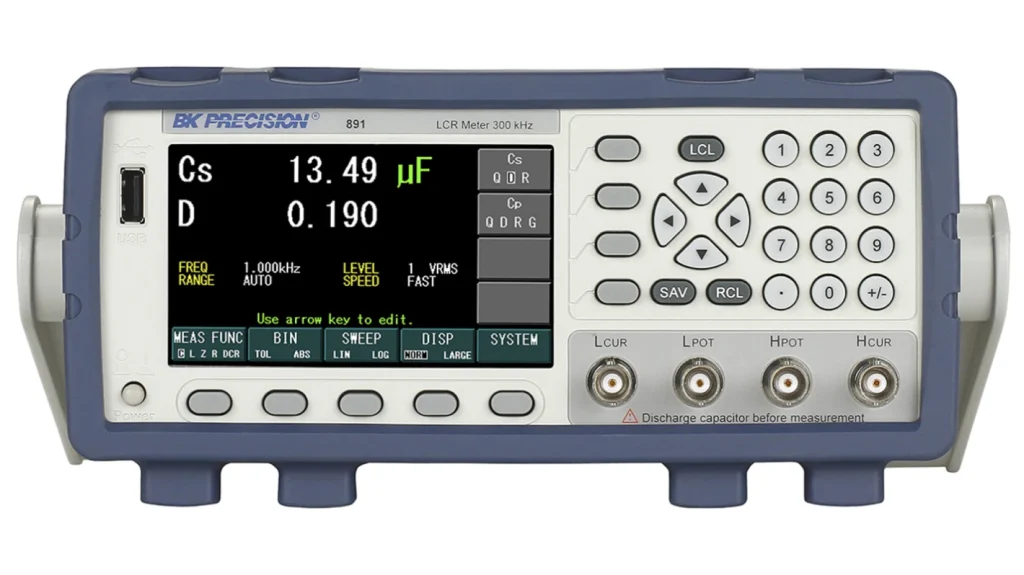
A bench LCR meter that measures inductors, capacitors, and resistors from 20 Hz to 300 kHz. A 4.3″ colour display shows all key parameters at once. Aimed at component characterization, incoming inspection, and small-production sorting.
Frequency: 20 Hz – 300 kHz, fully adjustable
Accuracy: 0.05% basic
Parameters: L, C, R, Z, G, B, Y, D, Q, phase angle, DCR
Functions: 9-bin go/no-go sorting, 300-point frequency sweep, adjustable measurement speed
Interfaces: USB, GPIB, LAN
Characterize capacitor ESR/D and inductor Q vs frequency across the full sweep. Fast bin sorting on a production bench. 0.05% basic accuracy is strong for the price class.
RF & Antennas
LiteVNA 64 – Vector Network Analyzer
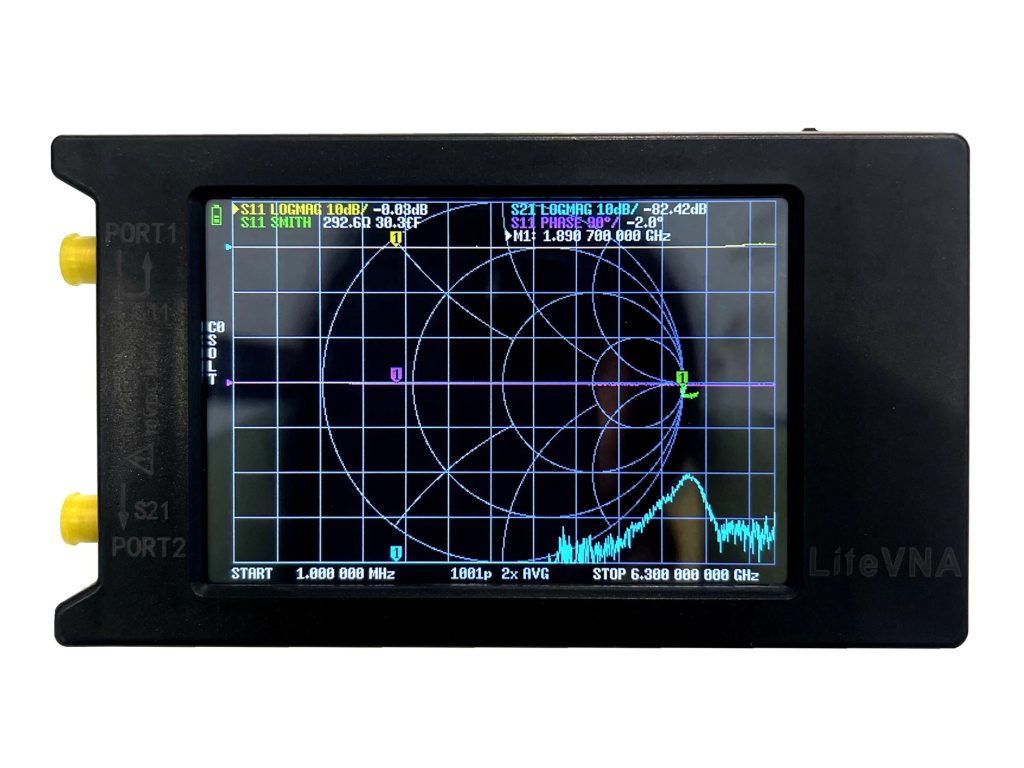
A pocket VNA that measures S11 (reflection) and S21 (transmission) from 50 kHz to 6.3 GHz. Uses a single mixer with internal RF switches, computes TDR/DTF (distance-to-fault) via IFFT. Runs standalone on a 4″ touchscreen with a battery, or tethered to a PC via NanoVNA-compatible software.
Frequency range: 50 kHz – 6.3 GHz
Measurements: S11 (reflection), S21 (transmission)
Derived: TDR / distance-to-fault via IFFT
Dynamic range: up to ~90 dB (tapers toward 6 GHz)
Functions: SWR, return loss, complex impedance/Smith chart, cable loss, filter response, SOLT calibration
Antenna tuning/SWR, filter and matching-network characterisation, coax fault-finding. Covers amateur radio, IoT, and 5.8 GHz WiFi/video-tx bands. Best performance is at HF/VHF/UHF – dynamic range and accuracy fall off toward 6 GHz. Always calibrate (SOLT) at the measurement plane before trusting readings.
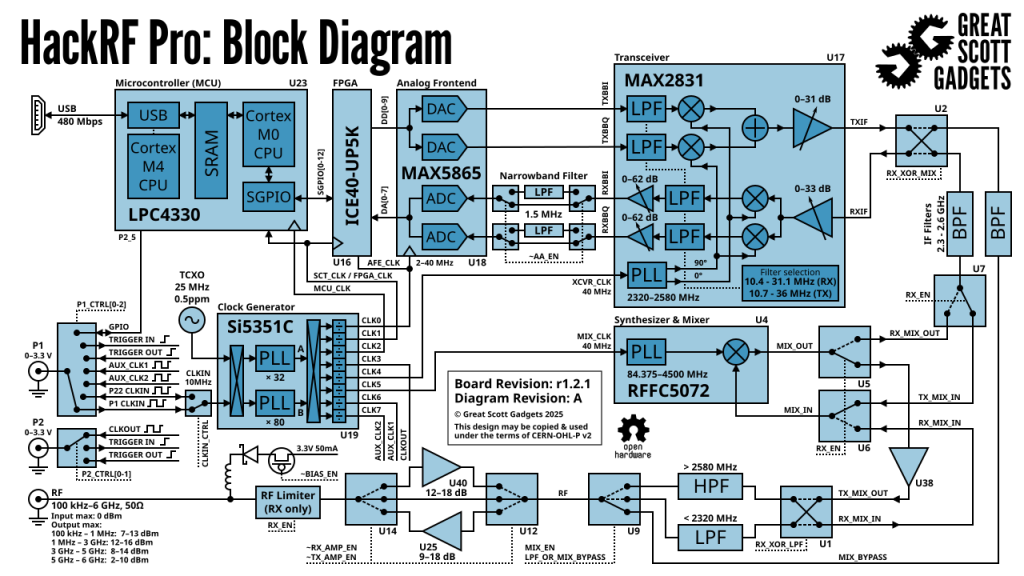
HackRF Pro – Software Defined Radio
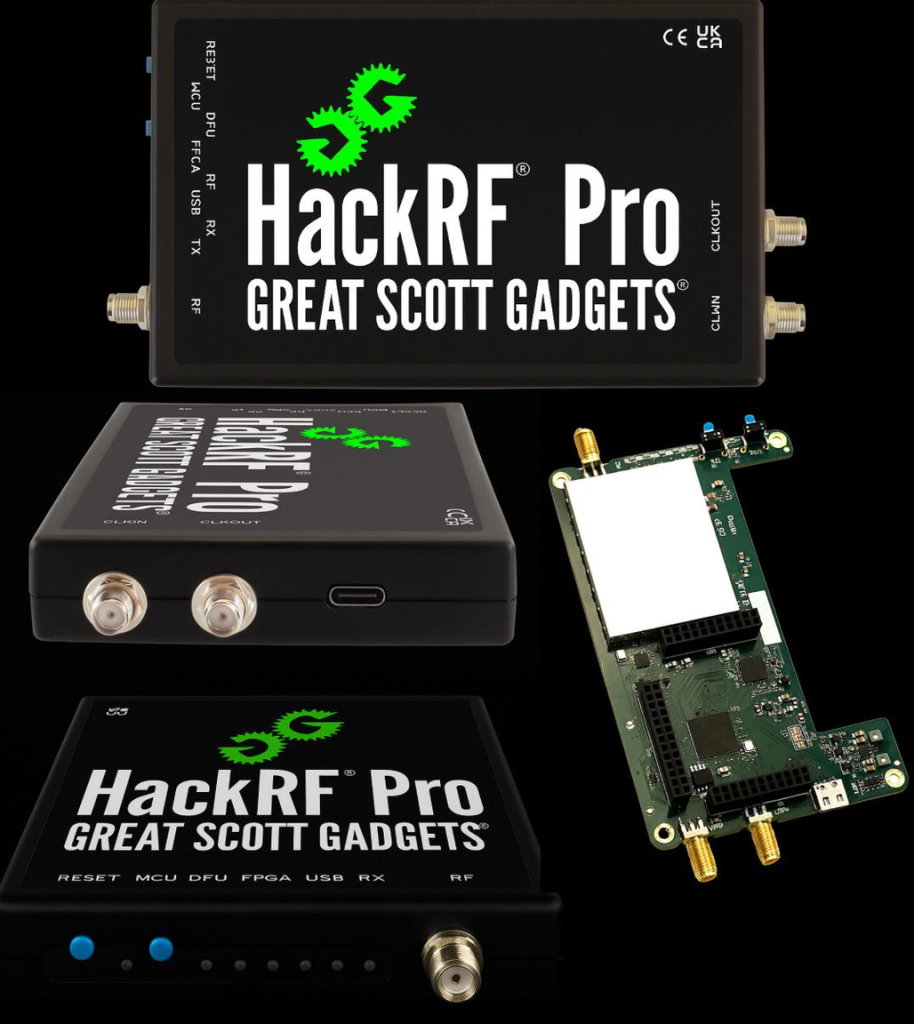
A USB software-defined radio that can receive or transmit across a very wide frequency range. HackRF Pro keeps the HackRF One architecture and software compatibility but improves RF performance, timing precision, and adds a TCXO, FPGA (vs CPLD), and USB-C.
Frequency: 100 kHz – 6 GHz (tuning 0 Hz – 7.1 GHz)
Duplex: Half-duplex (RX or TX, not both)
Sample rate: up to 20 Msps (8-bit I/Q)
Extended precision: 16-bit samples at low sample rates (typical ENOB 9–11)
Half precision: 4-bit at up to 40 Msps
Reference clock: Built-in TCXO
Broadband spectrum exploration, signal reverse-engineering, protocol RX/TX experiments, and RF education. Compatible with GNU Radio, SDR#, GQRX, and the standard hackrf tools. Half-duplex only – for simultaneous RX+TX you’d need two radios.